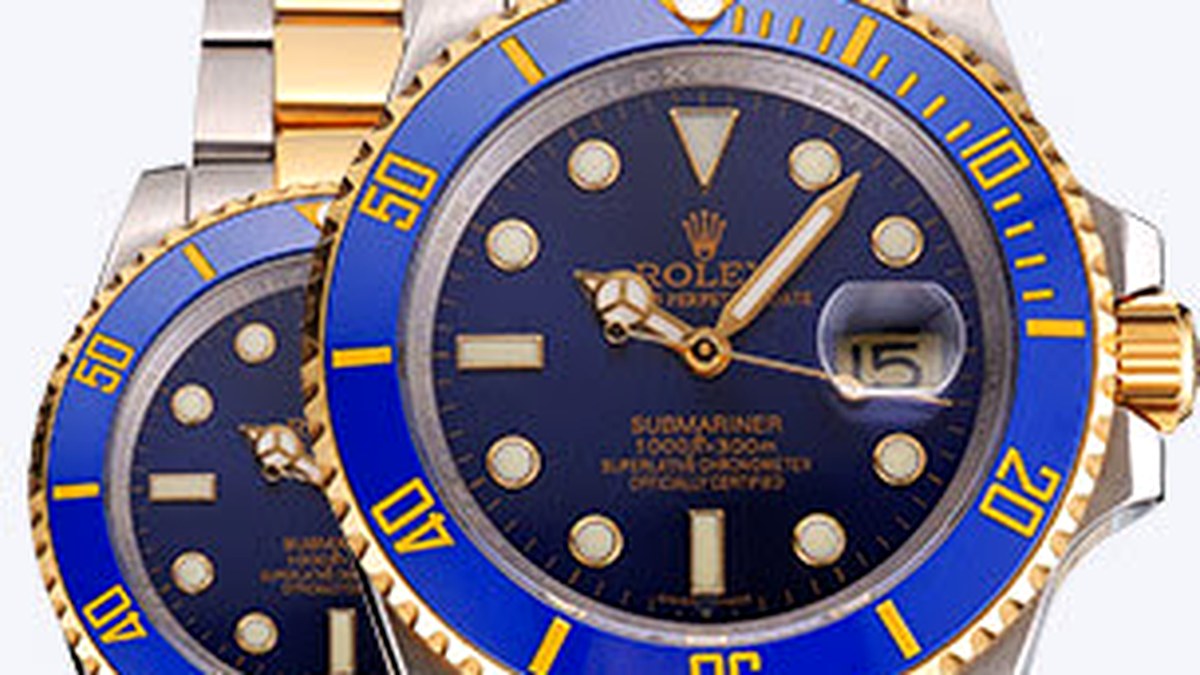
GMT-Master II quality starts with the GMT function
A GMT-style dial is easy to print; a convincing GMT function is more difficult. The crucial question is how the local hour hand, 24-hour hand and date interact. Some movements provide an independently adjustable local hour hand, while others adjust the 24-hour hand instead. Both can be useful watches, but they should not be described as mechanically equivalent.
Test every crown position
Ask for a video showing winding, local-hour adjustment, GMT-hand adjustment, date change and time setting. Observe whether the date changes when the local hour crosses midnight in both directions if that behavior is claimed. This functional sequence reveals far more than a rotor engraving.
Bezel color and numeral execution
Two-color ceramic-style bezels are visually demanding because the color boundary, engraved numerals and fill must all align. Lighting can shift blue, red, black, grey and brown tones significantly, so compare images taken in daylight as well as studio light. Check the 12 o'clock triangle, numeral depth and whether the bezel sits level with the crystal.
Hand stack and dial clearance
Four central hands require vertical clearance. Poorly executed stacks can leave excessive gaps or cause hands to touch. View the watch from the side and check whether the hour, GMT, minute and seconds hands sit parallel to the dial. Also inspect the GMT hand length and the way its arrow reaches the 24-hour scale.
Case, crown and bracelet consistency
A modern GMT-Master II-style build should be internally consistent: case proportions, crown guards, ceramic-style bezel and bracelet choice should belong to the same generation. Mixing an older reference's case cues with a newer bezel can create an attractive fantasy build but should not be marketed as an exact reference copy.
Compare the actual watch, not only the listing title
Require a video of every crown position and GMT-setting step, then verify bezel alignment, date behavior, hand stack and case dimensions on the exact watch.
Visit RetailerGMT QC checklist
- Verify which hand is independently adjustable.
- Test date changes across midnight in both directions if claimed.
- Check bezel color transition and zero alignment.
- Inspect the four-hand stack from the side.
- Check Cyclops/date centering on multiple numerals.
- Confirm case and bracelet details match the claimed generation.
“True GMT” and “caller GMT” should be defined by behavior
Community labels can become confusing. The practical distinction is which hand can be adjusted independently and how the date follows that adjustment. Ask for a demonstration instead of relying on terminology. A traveler-oriented local-hour jump is useful because it changes local time without stopping the movement, while a 24-hour-hand adjustment can still be practical for tracking another zone.
Test date direction through midnight
On movements with an independently jumping local hour, crossing midnight can move the date forward and, on some architectures, backward when traveling in the opposite direction. If the seller claims this behavior, request a video that demonstrates it. Incorrect or one-direction-only behavior is not necessarily a defect if the base movement is different, but it must be described honestly.
Bezel color boundaries are manufacturing clues
Two-color inserts are difficult because the transition must occur at precise locations while maintaining consistent surface finish and engraving. Inspect the boundary around numerals, not only the broad color fields. Bleeding, uneven tone or a boundary that shifts under different angles can signal surface treatment rather than a more integrated insert process.
GMT hand and minute hand clearance
Because the GMT arrow is large, a poorly set hand can touch the minute hand or sit visibly out of plane. Rotate the hands through 24 hours while observing clearance. Hand rub can stop the movement intermittently and may not appear in a short timing test.
Bracelet and clasp generation
GMT-Master II references have used different bracelets and clasp details over time. A modern case with an older clasp may be a deliberate hybrid, but it should not be counted as reference-accurate. Cross-check the intended reference before scoring the bracelet.
Daily-use accuracy versus GMT accuracy
The movement's basic rate and the GMT hand's alignment are separate issues. A watch can keep good time while the GMT hand points between 24-hour bezel markers because it was installed out of alignment. Check both after setting all hands precisely at a known reference time.
Check bezel indexing against the 24-hour hand
Set the GMT hand exactly to a known 24-hour reference and rotate the bezel to several offsets. The hand should read cleanly against the engraved scale. Poor bezel indexing, an inaccurately installed GMT hand or a miscentered dial can each create reading errors even if the movement itself tracks a second time zone correctly.
Travel-use testing
If you intend to use the watch while traveling, simulate the use case before purchase: move local time forward several hours, then backward, and confirm how the date behaves. This test reveals whether the architecture suits your needs better than a label such as “true GMT.”
Service access for GMT modules
Additional gearing can make repair harder than on a simple date movement. Ask whether the GMT function is native to the base caliber or added by a module, and whether parts are available. A watch that cannot be repaired economically after a calendar or hand-setting failure may not be a good daily traveler even if its initial QC is strong.
Frequently asked questions
What is the most important GMT replica question?
Ask exactly how the GMT complication works and request a crown-function video.
Does a moving 24-hour hand mean the movement matches a genuine GMT-Master II?
No. Different GMT architectures can move the 24-hour hand in different ways. Functional behavior must be identified precisely.
Why are two-color bezels hard to judge online?
Camera color, compression and lighting affect the transition and hue. Use multiple neutral-light photos.
Can a GMT replica use a reliable movement without matching Rolex architecture?
Yes. Reliability and architectural similarity are separate questions; the seller should describe the movement accurately.