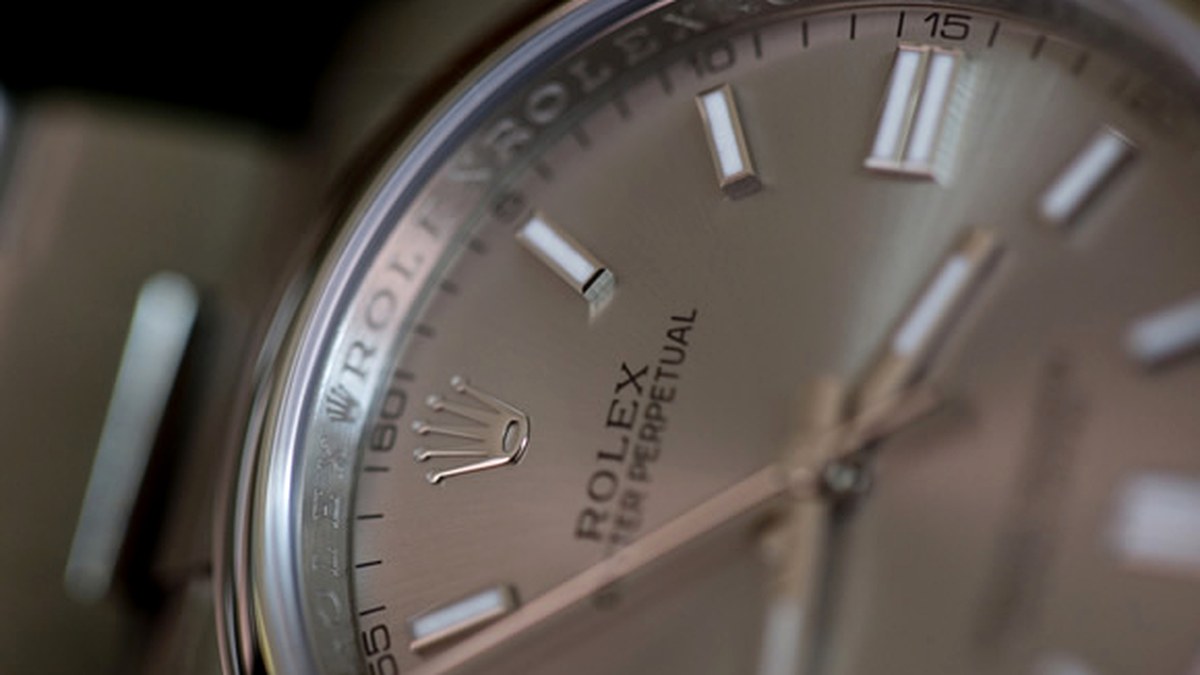
Why the 39mm Oyster Perpetual mattered
When Rolex introduced the Oyster Perpetual 39 ref. 114300 in 2015, the 39 mm case was one of the reasons the model attracted so much attention. It sat between traditional compact Rolex proportions and the larger sports-watch sizes that had become popular. This generation became known for the Red Grape and dark rhodium dial options, and that historical context is worth preserving.
The 114300 is now discontinued, so a modern listing should not present 39 mm as the current Oyster Perpetual size. Today's Oyster Perpetual family includes multiple sizes, including 41 mm, while older references such as the 39 mm remain relevant for people comparing discontinued designs.
The simplicity of the Oyster Perpetual makes mistakes easier to see
The Oyster Perpetual has no date window, Cyclops, rotating bezel or chronograph subdials to distract the eye. That makes dial printing, marker placement, hand length, bezel width and case finishing unusually important. A small error can stand out more than it would on a busier model.
The clean design can be compared with models such as the Explorer and Milgauss because the OP offered a clean, straightforward alternative. That is still a useful way to understand the watch: it is fundamentally about proportion, dial color and finishing rather than complications.
Dial color should be judged in more than one lighting condition
The 39 mm generation became known for distinctive colors such as Red Grape and dark rhodium. Color is difficult to evaluate from a single edited catalog image. Ask for natural-light photos and neutral indoor photos, because saturation, sunburst texture and marker contrast can change dramatically under different lighting.
On a replica, also inspect whether the applied markers are level, whether the coronet is centered, and whether the minute track is evenly spaced. A clean dial leaves little room for poor alignment.
Case size and bezel proportion
Do not compare a 39 mm 114300-style replica with a current 41 mm reference and then call the differences defects. First identify which generation the watch is intended to represent. Measure diameter if possible and compare the bezel-to-dial ratio, lug shape and bracelet width with the correct reference family.
Side-profile photography is especially useful. It can reveal an overly thick mid-case, a crystal that sits too high, or lugs that are too heavy even when the front view looks convincing.
Movement context: from calibre 3132 to modern 3230 references
The Oyster Perpetual 39 reference 114300 used Rolex calibre 3132. Modern 41 mm Oyster Perpetual references use calibre 3230. Those genuine specifications are useful as historical and functional baselines, but replica watches may use entirely different automatic movements.
For a replica OP, the practical questions are simpler: does the movement wind smoothly, set the time correctly, maintain reasonable power reserve, and have a service path? Because the Oyster Perpetual has no date complication, there is less justification for paying extra for a movement solely because it has decorative architecture.
Bracelet and clasp
The three-link Oyster-style bracelet is visually simple, so brushing, polished surfaces, end-link fit and clasp alignment should be inspected closely. Run a finger along the bracelet edges if you can; sharp edges and inconsistent finishing are common quality indicators that do not show well in listing photos.
QC checklist for an Oyster Perpetual-style watch
- Confirm the intended generation and case size before comparing proportions.
- Inspect dial color in more than one lighting condition.
- Check coronet, markers, minute track and hand alignment.
- Check bezel width and side-profile case thickness.
- Inspect Oyster bracelet articulation, end links and clasp.
- Verify the actual movement rather than relying on the product title.
- Request pressure-test evidence if the watch will be exposed to water.
Frequently asked questions
Is 39 mm still a current Oyster Perpetual size?
No. The 39 mm 114300 is a discontinued generation, but it remains popular and historically important.
Is the Oyster Perpetual easier to copy because it has fewer complications?
Mechanically it can be simpler, but visually the clean dial and bezel make proportion and finishing errors easier to notice.
What should matter more than an “AAA” label?
Correct size, dial alignment, case profile, bracelet quality, movement identity and individual-watch QC.