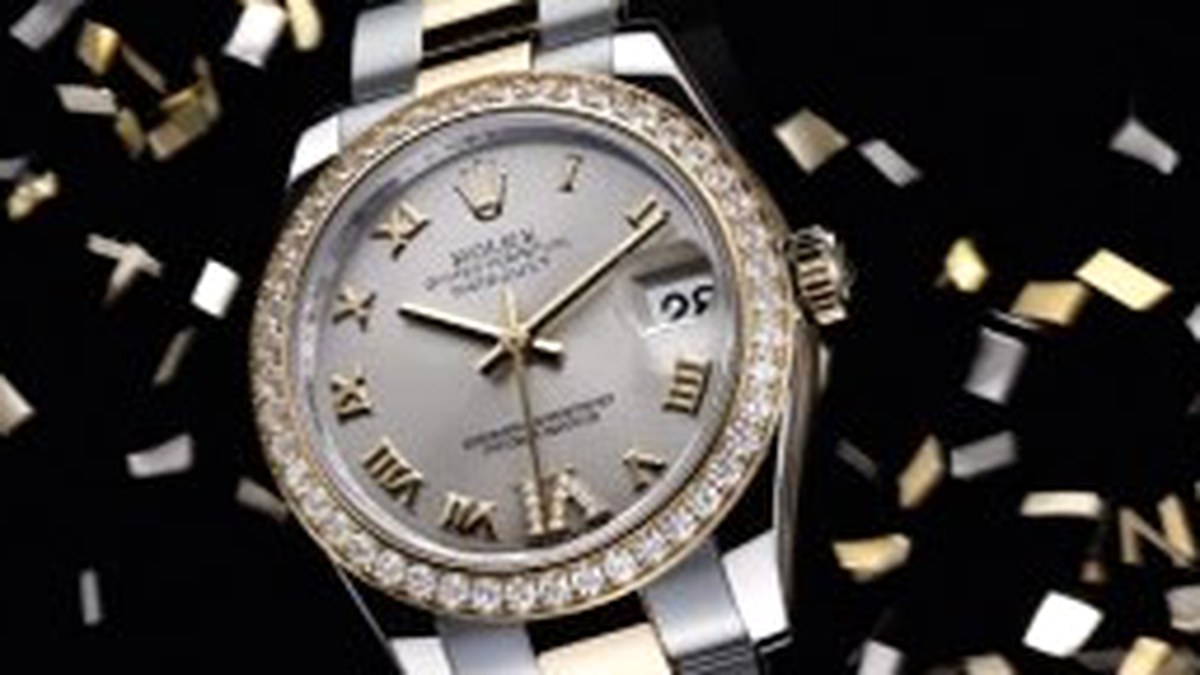
Why the Datejust became one of the most copied Rolex models
The Datejust is one of the Rolex models most frequently reproduced because the Datejust is one of the Rolex models most frequently reproduced because its design is instantly recognizable and it exists in a wide range of sizes, metals, bezels, dials and bracelets. That variety gives replica makers many configurations to imitate, but it also creates many opportunities to mix details that do not belong together.
Rolex introduced the Datejust in 1945. It is more accurate to describe it as the first self-winding wristwatch chronometer to display the date in a window on the dial, rather than the first watch of any kind to have a date. The date display later became one of the strongest visual identifiers of the model, especially with the addition of the Cyclops magnifying lens.
Datejust 36 and Datejust 41: start with the correct proportions
The Datejust has existed in many sizes, but 36 mm and 41 mm are the two most important modern men's configurations. A replica should not simply enlarge or shrink the same case. Dial opening, bezel width, lug shape, bracelet width and marker spacing all change the visual balance.
On a 36 mm Datejust, a bezel that is too thick or markers that are slightly oversized can make the dial look crowded. On a 41 mm model, the opposite problem occurs: narrow markers, thin hands or an undersized date window can leave too much empty space. Straight-on photos are useful, but side-profile photos are equally important for checking case thickness and crystal height.
Oyster and Jubilee bracelets
The original page correctly highlighted that the Datejust is commonly seen with both Oyster and Jubilee bracelets. The bracelet is not a minor styling choice. It changes how the entire watch looks and how errors are perceived.
A Jubilee-style bracelet has more links and more articulation, so check whether it drapes smoothly without excessive looseness. An Oyster-style bracelet has broader, flatter links, making uneven brushing and poor end-link fit easier to see. On either style, inspect taper, clasp alignment, screw quality and the transition from case to bracelet.
For a deeper bracelet comparison, see our Rolex bracelet guide.
Fluted, smooth and gem-set bezels
The original article referred to yellow gold, pink gold, steel and diamond-set versions. Modern Datejust configurations are more nuanced, and buyers should avoid assuming that any combination of dial, bezel and bracelet is reference-correct.
A fluted bezel should have consistent tooth geometry around the full circumference. Poor examples often look acceptable from the front but irregular when light moves across the edge. Smooth bezels reveal polishing quality more directly. Gem-set bezels add another layer of QC because stone spacing, setting height and symmetry become visible.
The Cyclops and date display
The date window is one of the best places to judge a Datejust-style watch. Check whether the date is centered vertically and horizontally, whether the font looks consistent, and whether the Cyclops is positioned squarely above the aperture. Do not judge magnification from a heavily angled listing photo; perspective can make a correctly aligned lens look distorted.
Calendar behavior matters too. Advance the date through several numbers and observe the transition around midnight. A watch that looks excellent in one still photo can reveal weak alignment or inconsistent printing as the date changes.
The old three-tier replica framework
The original RolexCopies.me article divided Datejust copies into inexpensive quartz watches, mid-range mechanical knockoffs and expensive “precise replicas.” That framework still describes how the market is often discussed, but the old price ranges are no longer reliable and the labels themselves do not guarantee construction quality.
| Tier | Typical approach | Important checks |
|---|---|---|
| Budget | Quartz or basic mechanical movement, simplified details | Basic function, bracelet quality, dial alignment |
| Mid-range | Automatic movement with closer visual finishing | Movement identity, case dimensions, Cyclops/date alignment |
| Higher tier | More detailed case, dial, bracelet and movement presentation | Individual QC, reference consistency, finishing and serviceability |
Movement claims
Older replica listings often treated “Swiss ETA” as the defining sign of a high-end Datejust copy. Today the movement should be evaluated on its own merits. A reliable automatic movement that can be serviced may be a better ownership choice than a decorated movement with an impressive label but uncertain parts availability.
A genuine modern Datejust 41 uses Rolex calibre 3235, but a replica does not need to copy that architecture to perform basic time-and-date functions. What matters is that the seller identifies the actual movement accurately and that the date-setting, winding and time-setting functions work correctly.
Datejust QC checklist
- Confirm whether the watch is intended to follow 36 mm or 41 mm proportions.
- Check bezel width and case profile from more than one angle.
- Inspect the date on several numbers, not only one.
- Check Cyclops alignment from a straight-on view.
- Inspect bracelet end links, taper, clasp and link articulation.
- Verify the movement and test winding, setting and date change.
- If the seller claims water resistance, request a pressure-test result.
Use the Rolex replica QC checklist before relying on labels such as “AAA+” or “Swiss made.”
Frequently asked questions
Is Datejust 36 easier to reproduce than Datejust 41?
Not automatically. Smaller dimensions make proportion errors more noticeable, while the larger 41 mm case exposes different issues with dial balance and case profile.
Is Jubilee better than Oyster on a replica Datejust?
Neither is inherently better. The correct choice depends on the intended configuration and the quality of execution.
Does a Swiss movement make the whole watch Swiss made?
No. A movement-origin claim does not establish the origin or quality of the complete watch.