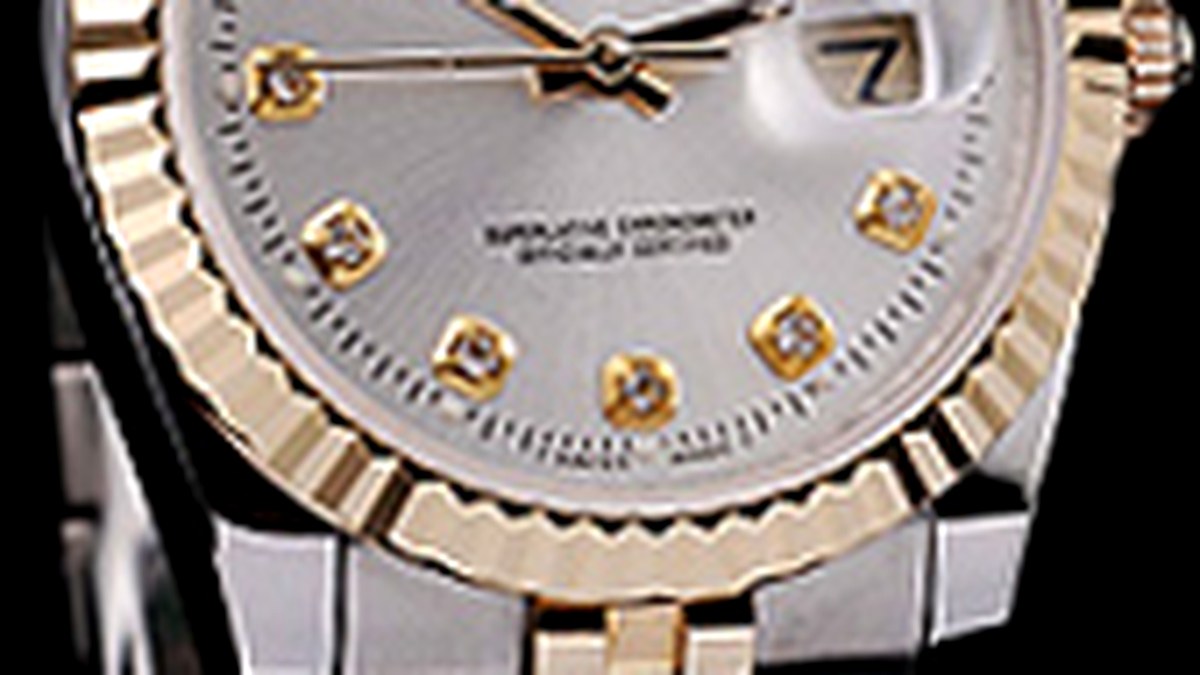
The Day-Date combines proportion and calendar challenges
The Day-Date places a full weekday display at 12 o'clock and a magnified date at 3, so calendar alignment dominates the dial. It also uses the President bracelet as a major part of its identity. A replica that focuses only on gold color can miss the details that make the model recognizable.
Day wheel and date wheel must be evaluated separately
Check several weekdays, not just the day shown in a seller photograph. The text should remain horizontally centered in the 12 o'clock aperture as the wheel advances. The date should also center under the Cyclops across single- and double-digit numerals. A calendar can appear correct on one day and expose printing or indexing errors on another.
Movement compatibility matters
MIYOTA's 8205 natively supports day and date at 21,600 vph, while the 8215 and 9015 are date-only movements. If a seller claims a date-only base caliber in a Day-Date-style watch, ask how the weekday function is implemented and whether the additional module affects thickness, hand height or servicing.
President-style bracelet
Inspect link articulation, end-link fit, taper, clasp action and surface transitions. Gold-tone finishes tend to reveal wear at moving contact points first, particularly between links, around clasp edges and where screws or pins are adjusted. A strong initial color match says little about long-term coating durability.
36 versus 40 mm proportions
A smaller Day-Date has less room for the weekday aperture, indices and date system, so alignment errors feel crowded. A 40 mm build has more visual space but makes lug mass and bracelet transition more important. Confirm the intended size before comparing dial details.
Compare the actual watch, not only the listing title
Verify the weekday/date behavior, calendar alignment, case dimensions, President-style bracelet and base movement on the actual Day-Date-style watch rather than trusting a caliber label.
Visit RetailerQC priorities
- Cycle through several weekdays and dates.
- Check Cyclops alignment square-on.
- Confirm whether the movement natively supports the displayed complications.
- Inspect President-style bracelet end links and coating wear points.
- Compare case proportions to the intended 36 or 40 mm generation.
Calendar typography is part of the model identity
The full weekday aperture uses much more text than a normal date window, so font width, baseline and wheel centering are highly visible. Check long weekday names such as WEDNESDAY and THURSDAY as well as shorter ones. A wheel that centers MONDAY may reveal horizontal indexing problems on a longer word.
Calendar transition timing
Observe when the day and date begin to move and when each finishes. Some base movements perform gradual changes and others use quicker transitions. The important point is consistency with the claimed architecture and reliable indexing after the change. If the day sits half-way in the aperture after transition, that is a functional QC issue rather than a cosmetic preference.
Module height affects the entire watch
Adding a day display to a date-only movement can increase dial-side thickness. That may force the hands higher, move the crown relative to the case, or require a deeper rehaut. Side photographs are therefore especially informative on Day-Date replicas. Compare crown/stem height to the center of the case and inspect hand clearance under the crystal.
Gold-tone consistency across moving parts
The President-style bracelet has many articulation points. Inspect the sides and undersides of links, clasp hinges and screw holes for base-metal exposure. A coating can look uniform on flat top surfaces while wearing quickly where links rub against each other.
Dial configuration plausibility
Day-Date dials exist in many colors and marker styles, which encourages fantasy combinations. If reference accuracy matters, verify whether the claimed dial color, bezel, case material and bracelet correspond to the same genuine family. If the watch is intentionally custom, evaluate it as a custom design rather than penalizing it for not matching a catalogue reference.
Service access for calendar parts
Day/date systems add parts that can fail even when the timekeeping train remains healthy. Ask whether replacement day and date wheels, jumper springs or modules are available. A rare decorated movement may become difficult to repair if the calendar system is proprietary.
Case material and dial choice should be evaluated together
Day-Date designs are strongly associated with precious-metal cases, so case color, bezel style, dial color and bracelet finish form a single visual system. A bright ice-blue style dial, for example, creates expectations about the surrounding metal tone. If the build intentionally mixes colors, treat it as custom; if it claims a particular reference, verify that the combination is plausible for that reference family.
Photography can make warm gold, rose tone and white metal look very different. Request daylight images and compare case, crown, bezel and bracelet in one frame. Color mismatch between components is often more informative than trying to match an online color swatch exactly.
Setting sequence and user experience
Operate the crown slowly through every position and note which direction sets day and date. A complicated, fragile or inconsistent setting sequence can make ownership frustrating even when the dial looks good. Ask whether there are restricted setting hours around midnight, because forcing calendar correction during transition can damage some mechanisms.
What to inspect after delivery
Cycle the full week, observe several date changes, measure power reserve and inspect coating wear after bracelet sizing. Calendar watches can reveal issues only after multiple transitions, so a longer return or inspection window is more valuable than a single pre-shipment photo.
Frequently asked questions
Is MIYOTA 8215 a native day-date movement?
No. MIYOTA lists the 8215 as a three-hand date movement. A weekday display requires a different movement or added mechanism.
Does “clone 3255” prove the movement matches Rolex calibre 3255?
No. Treat it as a seller claim until the architecture and functions are independently verified.
What exposes a poor Day-Date quickly?
Weekday centering, date/Cyclops alignment and President-style bracelet fit are strong early checks.
Can weight prove a solid-gold case?
No. Weight is only one clue and is affected by dimensions, bracelet construction and internal components.