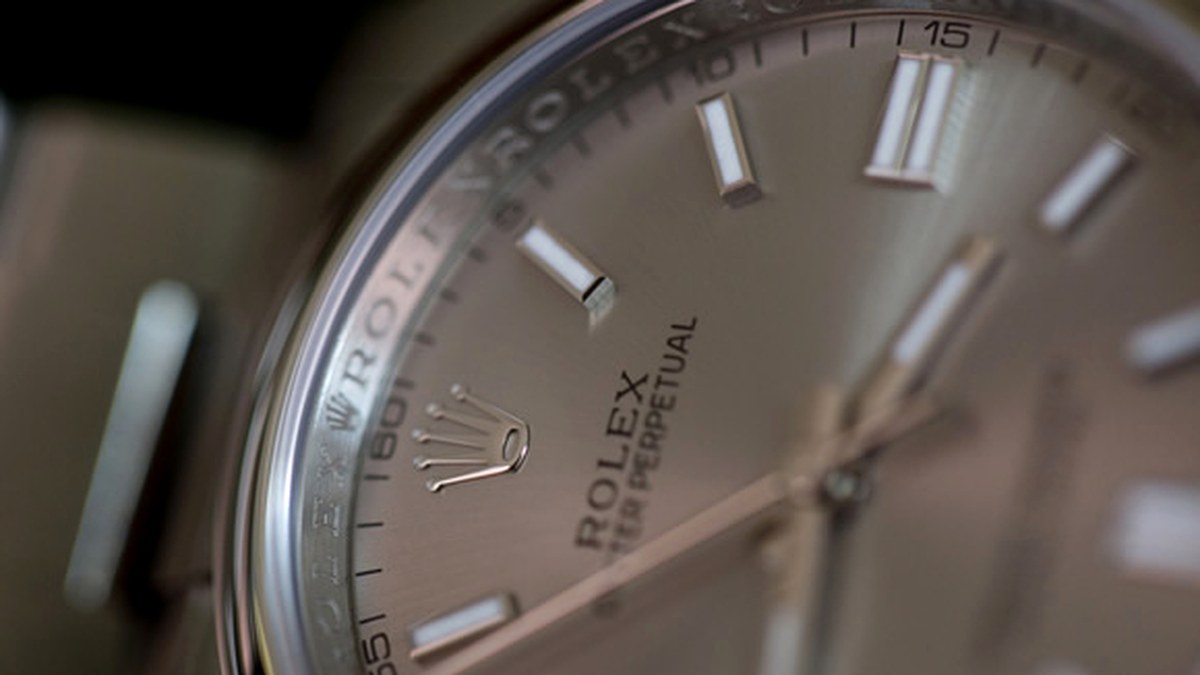
The dial is a system of relationships
A dial can contain individually sharp components and still look wrong if spacing is inconsistent. QC should compare marker positions, minute track, hands, coronet, text blocks, date aperture and rehaut as one composition.
Printing and applied markers
Use a straight-on macro photograph with neutral light. Check whether text baselines remain level, whether marker spacing is even and whether the applied coronet is centered. Uneven lume plots or adhesive around markers are easier to see when the camera is not using aggressive sharpening.
Hands and clearances
Hand lengths should correspond to their scales: the minute hand should reach the minute track appropriately, and central complications such as GMT or chronograph hands should clear each other. Side photographs can reveal an excessive hand stack or a hand that is not parallel to the dial.
Fluted, ceramic and rotating bezels
Different models require different evaluation. Fluted bezels depend on repeating tooth geometry; ceramic-style bezels depend on engraving, color and insert fit; rotating sports bezels add alignment and mechanical action. Do not use one generic “bezel quality” judgment for all models.
Rehaut and crystal relationship
A deep rehaut can make the dial appear smaller and the watch thicker. Check the crystal height, rehaut depth and bezel together from an oblique angle. On date models, the Cyclops must be evaluated as part of this optical stack.
Compare the actual watch, not only the listing title
Use neutral, high-resolution photographs from several angles to judge printing, marker placement, bezel alignment and finishing on the exact sample.
Visit RetailerMacro photography can create false confidence
Heavy sharpening makes printed edges look crisper while compression can erase dust and texture. Ask for one high-resolution original or lightly processed photo if dial finish matters. Compare multiple lighting conditions rather than scoring the dial from a single dramatic macro shot.
Applied-logo height and alignment
The coronet or applied logo should be checked not only for shape but also for vertical position, level and distance from the 12 o'clock marker. On some replicas the logo is individually well made but installed slightly off center, which becomes obvious when compared with the minute track.
Minute-track geometry
Track marks should meet the expected hand lengths and should maintain equal spacing around the full dial. Printing can distort near the edge if the dial blank or rehaut opening is poorly proportioned. Rotate the watch image mentally through all quadrants rather than focusing only on 12 and 6.
Bezel-to-crystal transition
Check whether the crystal sits too high or low relative to the bezel. This affects reflections and can make the bezel appear thinner or thicker. On rotating bezels, uneven vertical gaps around the circumference can indicate poor seating.
Date magnification as an optical system
Magnification depends on lens curvature, distance to the date wheel and viewing angle. A Cyclops that appears strong in one close-up may distort badly off-axis. Evaluate centering, usable field of view and the consistency of several date numerals.
Lume color versus application quality
Matching the exact hue is only one part of lume QC. Check application boundaries, marker-to-hand consistency and how the glow decays. Excessive paint height or uneven fill can be visible in daylight before lume performance is even tested.
Use geometry before typography
Collectors often focus on tiny font differences, but large geometric errors usually matter more: a miscentered dial, uneven marker radius, incorrect bezel diameter or wrong hand length changes the watch at normal viewing distance. Score those first, then move to micro-printing if the large proportions pass.
Inspect under multiple angles
Applied markers and polished hands can appear aligned from one angle because reflections hide edges. Tilt the watch slowly under one light source. Misaligned markers, uneven polishing and dust under the crystal become easier to detect when reflections move across the dial.
Bezel serviceability
Rotating bezels use springs, click mechanisms and retaining systems that can wear or be damaged during insert replacement. Ask whether the bezel can be serviced without proprietary parts. A cosmetically excellent insert is less valuable if the mechanism cannot be repaired after impact.
Use one repeatable macro-photo workflow
Take a straight-on image under diffuse light, then four closer images around the dial quadrants. Keep the camera parallel to the crystal whenever possible. This makes marker spacing, printing and bezel alignment easier to compare because perspective distortion is reduced. Dramatic angled photographs are useful for finish, but poor for geometry.
Printing should be judged as a system
Instead of zooming immediately into one letter, compare baseline alignment, spacing between text lines, overall weight and the relationship between printing and applied markers. A single character can vary with compression or sharpening, while an entire block of text sitting too high or too wide is a more robust visual signal. Inspect minute-track continuity separately because small spacing errors repeat around the full dial.
Applied markers: position, height and surface finish
Marker accuracy includes more than whether each marker points toward the center. Check equal height above the dial, parallel edges, consistent polished or brushed surfaces and uniform lume fill. Tilt the watch under a single light source; markers that are slightly twisted become obvious when their reflections change at different moments.
Bezel alignment needs more than a 12-o'clock check
On rotating bezels, inspect several indexed positions rather than only the triangle at 12. A bezel may center correctly at one position yet show uneven click spacing elsewhere. On fixed fluted or polished bezels, judge symmetry, edge definition and the transition into the crystal and case rather than looking for a rotational click.
Frequently asked questions
What is the best photo for dial QC?
A high-resolution straight-on image in neutral light, supplemented by an oblique side view for hand and rehaut depth.
Does perfect printing guarantee a good dial?
No. Marker placement, hand lengths, date aperture and overall spacing can still be wrong.
Why should bezel QC vary by model?
Because a fluted dress bezel, ceramic sports bezel and rotating dive bezel have different geometry and functional requirements.
Can camera sharpening hide problems?
It can exaggerate edges and text while masking surface texture, so ask for multiple uncompressed or lightly processed images when possible.